Showing posts with label Austen-based non fiction. Show all posts

Friday, 10 March 2017

MARINA CANO, JANE AUSTEN AND PERFORMANCE - THE 'PERFORMATIVE POTENTIAL' BEHIND AUSTEN WORKS

Dr Marina Cano has just published a very interesting study of Austen’s work and its afterlives. One chapter is dedicated to Jane Austen Fans; that is why I heard of Marina and her research before the book came out. She contacted me for her survey: am I not a truly devoted Austen fan who has the luck and joy to know a lot of truly devoted Austen fans?

I’m truly glad now to present the final work, Jane Austen and Performance, and to introduce  Dr Marina Cano  to you and let you discover more about her research in her own words.  She took some time to answer some questions and here’s the resulting interview.

When and How did you discover Jane Austen?

Like many of the fans who so generously answered my survey, I came to Austen through the film adaptations. In my case, it was Ang Lee’s Sense and Sensibility (1995)—with Emma Thompson, Kate Winslet, etc.—that made the trick. From there, I went to the novels—and more films!—Pride and Prejudice, Persuasion...And the rest is history!

How do you explain her being the most beloved author in English Literature?

This is the ultimate question I try to address in my book Jane Austen and Performance: I examine the “performative potential” behind her texts—in other words, her ability to make things happen. Readers “perform” her novels and her stories; they inhabit her characters on every reading, or every time they watch one of the film or stage adaptations, or revisit her stories in any way. And this does have an effect on people’s lives; it changes things, as so many of the wonderful respondents to my survey made clear. It might happen to some extent with other authors but not as much; I think it is what makes Jane Austen so special in English literature.

Sunday, 20 November 2016

TALKING JANE AUSTEN WITH ... HELENA KELLY, AUTHOR OF JANE AUSTEN THE SECRET RADICAL

Her just released  Jane Austen the Secret Radical  has been animating a new interesting debate around our beloved Regency lady. Helena Kelly has been under the spotlight in the latest days as the author of this interesting non-fiction book which uncovers Jane Austen as a radical, spirited and politically engaged woman writer. So those who have in their minds the tranquil, smiling woman on the new £10 pound banknote apparently got everything wrong about her.  

After receiving my review copy of this brilliant work and after reading its original analysis, I ended up with a few questions to ask Helena Kelly so I wrote them down and was graciously granted the answers. 

I must thank Helena for her kindness and generosity in the fuss that must have been the promotion of her book in the first days after the release. There have been reviews and interviews even in the major press, but she could find some spare time and answered my questions!  Here I am now, happy and proud,  to share my little interview with you.
Maria Grazia

*********************************************************
Hello Helena and welcome to our online Jane Austen book club! My first question is … I’ve always thought Jane Austen was rather revolutionary, but now you’ve taken a step ahead of me: a radical?

Hello, and thank you for inviting me! The title Jane Austen the Secret Radical isn’t actually mine, but it is a good choice for the book. I don’t know that Austen wanted to overturn things, but she did want to dig down and examine them, to show people how they actually worked, and that’s what radicalism is about, isn’t it, getting down to the ‘radix’, the root of things.

Monday, 19 September 2016

NEW RELEASE! THE JANE AUSTEN WRITERS' CLUB - INTERVIEW WITH AUTHOR REBECCA SMITH & GIVEAWAY


“This guide steers away from lists of how-tos, filling a niche for readers and writers who are as interested in experiencing the journey to better writing as arriving at the destination.” Library Journal

The Jane Austen WritersClub is out tomorrow in the US! It is the first creative writing guide to look at the methods and devices used by the world's most beloved novelist.

Here Rebecca Smith examines the major aspects of writing fiction—plotting, characterization, openings and endings, dialogue, settings, and writing methods—sharing the advice Austen gave in letters to her aspiring novelist nieces and nephew, and providing many and varied exercises for writers to try, using examples from Austen's work. These include:

Show your character doing the thing he or she most loves doing. In the opening scene of Persuasion, Sir Walter Elliot looks himself up in the Baronetage, which is the Regency equivalent of Googling oneself. That single scene gives us a clear understanding of the kind of man he is and sets up the plot.

Monday, 12 September 2016

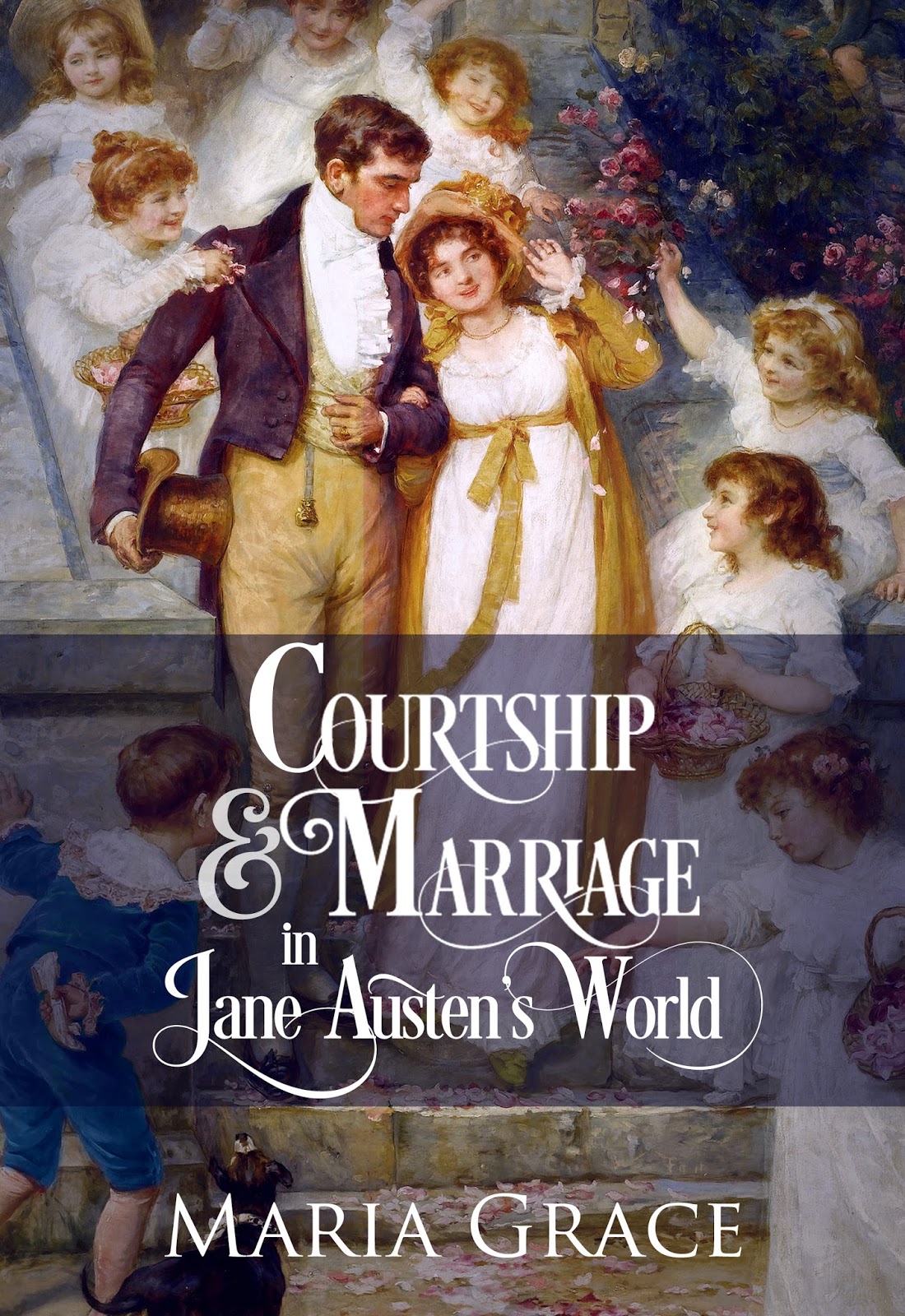
MARIA GRACE, COURTSHIP AND MARRIAGE IN JANE AUSTEN'S WORLD + GIVEAWAY

Thanks so much for having me, Maria Grazia! I love getting to visit with you.  

I’m so excited to share with you and your readers about courtship and marriage in Jane Austen’s day. Customs have changed so dramatically in the two centuries since Jane Austen wrote her novels that things which were obvious to her original readers leave readers today scratching their heads and missing important implications. It’s amazing how much of Austen’s stories we miss not understanding the context she wrote it.

One of the most bewildering aspects of marriage in the regency era was the legal position of women in the era. Single and widowed women enjoyed very different legal status than married women whose legal personhood was subsumed into her husbands in a doctrine called coverture..  

This excerpt from Courtship and Marriage in Jane Austen’s World explains more about coverture and what it meant to women.


Married Women's Legal Position in the Regency

In 1765, William Blackstone presented a common man’s language interpretation of English law. He explains the law’s approach to women’s legal existence and rights in marriage which remained largely unchanged until the Married Women’s Property Act of 1884.
Blackstone said: By marriage, the husband and wife are one person in law: that is, the very being or legal existence of the woman is suspended during the marriage, or at least is incorporated and consolidated into that of the husband… and her condition during her marriage is called her coverture.… For this reason, a man cannot grant anything to his wife, or enter into covenant with her: for the grant would be to suppose her separate existence; and to covenant with her, would be only to covenant with himself: … a husband may also bequeath anything to his wife by will; for that cannot take effect till the coverture is determined by his death.… the chief legal effects of marriage during the coverture; upon which we may observe, that even the disabilities which the wife lies under are for the most part intended for her protection and benefit: so great a favourite

Wednesday, 11 June 2014

SPOTLIGHT ON ... 'JANE AUSTEN AND NAMES' BY MAGGIE LANE + GIVEAWAY

"They say his name is Henry. A proof of how unequally the gifts of Fortune are bestowed — I have seen many a John & Thomas much more agreeable. " (from J. Austen,  Letters)

What's in a name? According to William Shakespeare - or better his Juliet -  not so much, "That which we call a rose. by any other name would smell as sweet". But Maggie Lane thinks otherwise and has researched the importance given to names by Jane Austen, especially in her mature work. That means Ms Lane focuses her analysis on the major six novels: Pride and Prejudice, Sense and Sensibility, Mansfield Park, Emma, Northanger Abbey and Persuasion. 
In the six sections of the book, the author proposes interesting reflections, comparisons and analysis related to the use of names in history, in Jane Austen's time and in Jane Austen's most famous novels: A Brief History of Names, Naming Patterns and Practices, The Use of Christian Names, Jane Austen's Feeling For Names, Names in the Novels of Jane Austen: An Alphabetical Index.
Take your chances to win 1 of the 5 ebook copies I was kindly granted  to give away among you readers. It's a precious addition to any Austenite's collection! Check out the giveaway contest in the rafflecopter form below this post.

Tuesday, 6 August 2013

TALKING JANE AUSTEN WITH ... DEBORAH YAFFE, AUTHOR OF "AMONG THE JANEITES: A JOURNEY THROUGH THE WORLD OF JANE AUSTEN FANDOM"

First of all Deborah, welcome to our online book club. I’m really glad you’re here today to introduce yourself and your new book to our readers.
Thank  you for inviting me!

Of course, my first question is:  “How did it come that you  decided to write about  Austen  fans,  the so – called Janeites” ?
I’ve been an Austen fan since I was a child, and over the years I attended a couple of the Jane Austen Society of North America’s annual conferences, which I loved.  About eight years ago, I read Karen Joy Fowler’s novel The Jane Austen Book Club and decided it would be fun to found a book club like that, dedicated to reading all the novels in order. I roped several neighbors into the group, and during our Pride and Prejudice discussion, a question came up about the entail, that legal device that’s so important to the inheritance issues in P&P. The next day, trying to research this question online, I decided to drop in on the Republic of Pemberley, the largest online Austen fan site, which I’d vaguely heard of but never visited.  I fell instantly in love with this community of fellow Austen obsessives  and started spending inordinate amounts of time there, to the point that I would get embarrassed when my husband caught me at it – after all, I was supposed to be hard at work on a book on a completely different subject.  One day, I was telling him about this wonderful community and its many quirky personalities, and he said, “You should write a book about that.” It took me a few years, but eventually I did.

Wednesday, 24 July 2013

TALKING JANE AUSTEN WITH ... EMILY BRAND, AUTHOR OF MR DARCY'S GUIDE TO COURTSHIP


Thanks Emily for taking the time to answer my questions and agreeing to talk Jane Austen with me. This is my first curiosity:  when and how did you come to write a Jane Austen sequel?

Mr Darcy’s Guide to Courtship is more of a prequel: it is set shortly before the events of Pride and Prejudice, and imagines the advice that Darcy might have given Bingley on how to attract a suitable lady before he is let loose on Hertfordshire’s female population.

As an historian, my recent research has focused on the real seduction manuals – often just collections of what we’d now call ‘chat up lines’ – that were in circulation in and around Jane Austen’s lifetime. Many of them are really entertaining, and I wanted to bring them back into public view somehow. Austen’s books have been a part of my life for as long as I can remember, and it only seemed right to reveal how men really went about winning a lady’s affections through the medium of Regency England’s most eligible bachelor himself!

Wednesday, 8 May 2013

ONE THING NEW INTERVIEWS THE AUSTEN HERO OF THE DAY - PROFESSOR MICHAEL CHWE


There’s a famous scene in Jane Austen’s Pride and Prejudice in which Mr. Darcy’s aunt, the imperious Lady Catherine de Bourgh, tries -- and fails, spectacularly -- to browbeat the heroine, Elizabeth Bennett, into promising not to marry Mr. Darcy. For Austen fans, Elizabeth’s refusal to make such a promise is just more evidence how smart, strong and sassy a heroine she is.  
For UCLA political science professor Michael Chwe, it’s an example of something else altogether: strategic game theory, or the study of how people optimize choice when interacting with others. In his new book, Jane Austen: Game Theorist, Chwe aims to show that Austen, in fact, was one of the earliest game strategists.

In the case of Pride and Prejudice, Chwe says Lady Catherine’s fatal

flaw lies in her failure to recognize that Elizabeth’s refusal will actually spur Mr. Darcy, who still pines for Elizabeth, into action. As Darcy tells Elizabeth after the fact: “It taught me to hope as I had scarcely ever allowed myself to hope before. I knew enough of your disposition to be certain that, had you been absolutely, irrevocably decided against me, you would have acknowledged it to Lady Catherine, frankly and openly." Chwe says this example of Lady Catherine’s “cluelessness” shows how she is ultimately outsmarted as Elizabeth and Darcy marry.

I asked Chwe how Austen’s strategic thinking is applicable today and to share his favorite example of what he calls “strategic manipulations” -- examples of how her heroines outsmart others -- in her work

Saturday, 30 March 2013

TALKING JANE AUSTEN WITH ... KATHLEEN ANDERSON & SUSAN JONES, AUTHORS OF JANE AUSTEN'S GUIDE TO THRIFT

Welcome at My Jane Austen Book Club, Kathleen and  Susan! I'm always really glad when I find new Janeites to share with. Then, if they happen to be teachers of English literature like me, I become very curious. So, my first question is linked to my job, our job. Do you teach Jane Austen and what do you think young people can learn from her?

Susan: I do teach Jane Austen, especially in upper level courses where students need to connect with excellent writing.  Austen models the level of perfection a writer can achieve through scrupulous review and revision:  sentence clarity and style, precise word choice, understanding of audience, to name a few.  You don’t reach millions of readers over two centuries without doing your homework in those areas.

Kathleen: We incorporate Austen novels into our courses whenever possible.  We all have so much to learn from Jane Austen.  Especially young people can become more sensitized to effective, grammatical, elegant language by absorbing her beautiful, witty narrative style.  Moreover, all of the novels emphasize the importance of the feelings of others and of the preservation of the social fabric, a beneficial reminder to all of us.  We often forget that we live in community.

Saturday, 19 January 2013

P&P ANNIVERSARY - CELEBRATING JANE AUSTEN’S PRIDE AND PREJUDICE: 200 YEARS OF JANE AUSTEN’S MASTERPIECE BY SUSANNAH FULLERTON


The celebrative atmosphere all around the Net has made me look for the perfect read to join the festive mood in honour of the 200th anniversary of Pride and Prejudice. What about this just released book by Australian Austen scholar, Susannah Fullerton? 


The Book - Celebrating Pride and Prejudice

“Think only of the past as its remembrance gives you pleasure,” Elizabeth Bennet tells Fitzwilliam Darcy in one of countless exhilarating scenes in Pride and Prejudice by Jane AustenThe remembrance of Austen’s brilliant work has given its readers pleasure for 200 years and is certain to do so for centuries to come. The book is incomparable for its wit, humor, and insights into how we think and act—and how our “first impressions” (the book’s initial title) can often be remarkably off-base. All of these facets are explored and commemorated in Celebrating Pride and Prejudice, written by preeminent Austen scholar Susannah Fullerton. Fullerton delves into what makes Pride and Prejudice such a groundbreaking masterpiece, including the story behind its creation (the first version may have been an epistolary novel written when Austen was only twenty), its reception upon publication, and its tremendous legacy, from the many films and miniseries inspired by the book (such as the 1995 BBC miniseries starring Colin Firth) to the even more numerous “sequels,” adaptations, mash-ups (zombies and vampires and the like), and pieces of merchandise, many of them very bizarre.

Wednesday, 7 November 2012

MEET REBECCA SMITH, JANE AUSTEN'S GREAT-GREAT-GREAT-GREAT-GREAT NIECE - GIVEAWAY OF HER MISS JANE AUSTEN'S LIFE'S DILEMMAS

Rebecca Smith at Jane Austen's House Museum.
 Photo by Isabel Snowden

My guest today is really special to me and I hope you'll be ready to welcome her and make her feel at home here at My Jane Austen Book Club.

Rebecca Smith is the author of three novels published by Bloomsbury: The Bluebird Café (2001) Happy Birthday and All That (2003) and A Bit ofEarth (2006). Barbara Trapido called her “the perfect English miniaturist”.
Rebecca studied History at the University of Southampton and is now a Teaching Fellow in English and Creative Writing there. From autumn 2009 until summer 2010, Rebecca was the Writer in Residence at Jane Austen’s House Museum in Chawton, Hampshire; she continues to work closely with the Museum. Her first work of non-fiction,Jane Austen’s Guide to Modern Life’s Dilemmas, has just been published in North America and the UK. Rebecca is Jane Austen’s great great great great great niece.

Rebecca’s first novel for children, Shadow Eyes, was shortlisted for The 2012 Kelpies Prize and will be published sometime in 2013. She is currently working on another novel.

Here are her answers to a few  questions about her Austen-inspired book and her writing. Check the giveaway details below this post and take your chances to win in the rafflecopter form. Good luck!


While researching Miss Jane Austen’s Guide to Modern Life’s Dilemmas, you immersed yourself in Jane Austen’s books as well as her letters and early writings. What were some of the most surprising things you learned about Austen in the process?

I found that I could answer every single dilemma with advice from Jane’s work or letters! Dozens and dozens of different dilemmas were suggested by family, friends and my students – there were too many to fit into the book – but all of them could have been answered. The more I read, the more I saw answers.  I kept thinking of extra dilemmas that I’d like to include. I found that Jane’s wit and wisdom could be applied to anything.

Sunday, 23 September 2012

AUTHOR GUEST POST- SANDY HAYDEN, FINDING MR DARCY


Why would a modern woman want to find a man who, at first glance, appears to be both arrogant and aloof, not to mention condescending?  Only after knowing him for more than a year did Elizabeth Bennet discover the “real” Mister Darcy under the cold and intimidating mask he showed to society. Dear Reader, if you finished the book, you know that Mister Darcy’s true nature made him the good husband material that Mrs. Bennet hoped to find for all of her daughters. In short, he “had much to recommend him”.  (If you didn’t finish “Pride and Prejudice”, you will find a short summary of it at the end “Finding Mister Darcy”.

Jane Austen’s works are almost two hundred years old.  Although the clothing and language are changed, her advice still rings true.  And her works are still serving as the basis for countless new novels and movies.  It seems human nature and the workings of society remain the same no matter how much their appearance differs. 

Wednesday, 12 September 2012

FROM MY AUSTENESQUE SHELF - QUICK REVIEWS & GIVEAWAY

2012 was a feast for any fan of Austen-inspired fiction and non-fiction. Lots of new books were released and I've been able to read and enjoy many of them as well as  to interview or feature their talented authors here at My Jane Austen Book Club. My bookshelf  labelled Austenesque is crammed with review copies and lovely paperbacks. Would you like to get one? I'm ready to give away one book at your choice among the ones below. Read my quick reviews and choose the book you like best among Austentatious by Alyssa Goodnight, His Good Opinion by Nancy Kelley and All Roads Lead To Austen by Amy Elizabeth Smith. Then leave your comment adding your e-mail address. Spread the word through twitter or facebook, your blog or site! This contest is open worldwide and ends at the end of the month, September 30th.

HIS GOOD OPINION BY NANCY KELLEY

Though tired of Society's manipulations, Darcy never thought to be enchanted by a country maiden. However, on a visit to rural Hertfordshire, Elizabeth Bennet captivates him. Lovely and vivacious, she is everything he is not and everything he longs to have. Unfortunately, her connections put her decidedly beneath him, and the improprieties he observes in her family do not win his favour. Putting her firmly out of his mind, Darcy returns to London, but Elizabeth is not so easily forgotten.

Saturday, 25 August 2012

JANE AUSTEN AND CHILDREN - BOOK REVIEW

(2010 - hardcover - 256 pp.)
(guest blogger Nancy Parker)

David Selwyn, the chairman of the Jane Austen Society and a leading authority in his field (editor of the Annual JAS Report since 2001,  and author of numerous works and articles on Austen), does a remarkable job highlighting her relationship with children in her novels in his  2010 book, “Jane Austen and Children.” Although not a mother herself, Austen’s works examine the relationships of children and their parents, as well as the role of children in society, how children function as models of behavior, and the nature of childhood. Austen understands that childhood and parenthood are multi-faceted, and Selwyn too knows that in order to investigate Austen’s interpretation of childhood, he must come at it from a multi-dimensional perspective. His expansive work highlights the unseen child as well as the historical background surrounding parenting and the morals of childrearing in this time.


One of the most effective aspects of Jane Austen and Children is the way in which Selwyn demonstrates how the unseen child is sometimes just as important as the child that is explicitly illustrated, as he shows how children who are not present in the novels are just as important as those who are. In a time when many women and children died during the arduous process of childbirth, it is significant to note how important it is that many of the family members who were not alive had just as important of an impact on the family sphere as those who were. As far as birth practices go, one of the most fascinating aspects of the novel was Selwyn's in depth look at the birthing practices of this time, a load of information that would make any modern mother thankful she was not alive in the 18th century.

Saturday, 16 June 2012

ALL ROADS LEAD TO AUSTEN BY AMY ELIZABETH SMITH - GIVEAWAY WINNER


This is the book you should take with you on holiday for the right fix of Austen - inspired non fiction. A travel book full of amusing anecdotes, real experiences, interesting meetings and a lot of Jane Austen! Amy Elizabeth Smith has given Janeites a new perspective on their beloved writer's novels and a cross-cultural approach to those familiar tales.

Thursday, 31 May 2012

THE JANE AUSTEN GUIDE TO LIFE BY LORI SMITH - GIVEAWAY WINNER


The draw for this giveaway contest, as usual via random.org, has chosen The Sampler Girl - Tanya as the winner of this lovely book. Congratulations and thanks for taking part. Many thanks to Lori Smith for being my guest here at My Jane Austen Book Club . And if you haven't read it, don't miss her interview (HERE).

Thursday, 24 May 2012

AUTHOR INTERVIEW & GIVEAWAY - LORI SMITH & THE JANE AUSTEN GUIDE TO LIFE


As a child, Lori Smith’s mother had to pay her to read books.  So it’s a bit ironic that she now gets paid to write them.  Lori feels connections to Austen on many levels—as a writer, a single woman, an Anglican, and as someone struggling with a mysterious chronic illness. For her last book, A Walk with Jane Austen: A Journey into Adventure, Love, and Faith, Lori spent a month in England tracing Austen’s life and works. Readers voted to give that book the Jane Austen Regency World Award for best nonfiction.
Her writing has also appeared in Washington Post Book World, Publishers Weekly, Beliefnet.com, Skirt!, and Today’s Christian Woman.  Lori lives in Northern Virginia with her sweet but stubborn English lab, Bess.

In your new book,  your second Austen-dedicated one, The Jane Austen Guide to Life: Thoughtful Lessons for the Modern Woman , you point our how much Jane Austen has to teach to contemporary women. What is lesson number one, the basic one?

Monday, 30 April 2012

ALL AROUND THE WORLD WITH JANE - GREAT PRIZES FROM SOURCEBOOKS!


In the June memoir, All Roads Lead to Austen the author Amy Elizabeth Smith took Jane Austen’s works along with her as she travelled to foreign countries. Her goal was to see if the magic of Jane Austen could hold its power across borders, languages and cultures. 

Blurb -  With a suitcase full of Jane Austen novels en español, Amy Elizabeth Smith set off on a yearlong Latin American adventure: a traveling book club with Jane. In six unique, unforgettable countries, she gathered book-loving new friends— taxi drivers and teachers, poets and politicians— to read Emma, Sense and Sensibility, and Pride and Prejudice.
Whether sharing rooster beer with Guatemalans, joining the crowd at a Mexican boxing match, feeding a horde of tame iguanas with Ecuadorean children, or tangling with argumentative booksellers in Argentina, Amy came to learn what Austen knew all along: that we're not always speaking the same language— even when we're speaking the same language.
But with true Austen instinct, she could recognize when, unexpectedly, she'd found her own Señor Darcy.
All Roads Lead to Austen celebrates the best of what we love about books and revels in the pleasure of sharing a good book— with good friends.

Amy took Jane to far off countries – now her publishers at Sourcebooks want your help to take her even further! They are holding a contest called All Around the World with Jane! If you wish to join them on their  Austen love fest you should print out the Jane Austen “flat Stanley.”  ( see picture below) . Take pictures of yourself with Jane in your hometown or on your vacation, and submit it from April 30th – June 30th!


Sourcebooks publishers will award the following prizes to the individuals with the most creative picture:

1 Grand Prize Winner will receive:
  • An E-reader with all of our available Austen sequels/continuations downloaded on to it
  • A signed copy of All Roads Lead to Austen by Amy Elizabeth Smith
  • A Skype session with Amy Elizabeth Smith
3 Second Place Winners will receive:
  • A signed copy of All Roads Lead to Austen by Amy Elizabeth Smith
  • A choice of 5 Jane Austen sequels/continuations from Sourcebooks
5 Third Place Winners will receive:
  • A signed copy of All Roads Lead to Austen by Amy Elizabeth Smith
 You can then submit your pictures on the All Around the World with Jane Facebook page or email your submission to landmark@sourcebookspr.com.

Below are some examples of where Jane has been already ( The Jane Austen Centre in Bath and Times Square, NYC) along with the flat Stanley that you can print off (also available on the Facebook page). 

  
One more thing! Barnes & Noble will be offering this title as a NOOK early exclusive and will be offering the e-Book at $6.99 starting Monday April 30thfor a limited time!

Amy Elizabeth Smith will be my guest on June 8th. Stay tuned!

Friday, 6 April 2012

GIVEAWAY WINNER - ELIZABETH KANTOR, JANE AUSTEN GUIDE TO HAPPILY EVER AFTER


This giveaway contest linked to the author guest post about Jane Austen and happy endings by Elizabeth Kantor ends today. So, following Jane Austen's example,  I'm here to give this story a happy ending! I'm  ready to announce the name of the winner: 
the happy ending of "our  story"  is for ... Gayle Mills


Wednesday, 28 March 2012

ELIZABETH KANTOR AND JANE AUSTEN'S HAPPY ENDINGS - GUEST POST AND GIVEAWAY

Elizabeth Kantor is the author of The Jane Austen Guide to Happily Ever After , which will be published on April 2nd and is already shipping from Amazon.  She is visiting here at My Jane Austen Book Club today to tell us about how Jane Austen creates her happy endings and how we can re-create them. Enjoy her guest post, leave your comment + your e-mail address to enter the giveaway contest to win the book. US readers only. The giveaway ends on April 6th when the name of the winner is announced. Good luck!


Endorphins Out of Ink and Paper: How Jane Austen Creates Her Happy Endings (and How We Can Re-Create Them) 

Jane Austen is past mistress of the truly happy ending. Elizabeth with Darcy, Anne Elliot with Captain Wentworth--the last chapters of their stories capture exactly what we all long for in love. But they're not just mouth-watering happily-ever-after endings. What makes them even better is, they're believable. My husband quotes the professor who taught him Pride and Prejudice in college: It's one of the only happy endings in all of literature that is really believable. You can actually imagine Elizabeth and Darcy as a happily married couple.

So how does Jane Austen do it? What's her recipe for compounding endorphins out of ink and paper?

And--a question even more interesting to us 21st-century women--can the kind of happiness that Jane Austen figured out how to create on paper be re-created in real life? Can we follow her map to discover the wellsprings of happy love?

Now Jane Austen would not have been at all surprised to find her readers looking to and even imitating her characters in the hopes of finding their own happy endings. It's a major theme of her fiction--from the juvenilia and Northanger Abbey (where Catherine gets into all kinds of trouble expecting life to be like a Gothic novel) to her last, unfinished novel, Sanditon (where Sir Edward Denham is deliberately modeling himself on Lovelace in Samuel Richardson's Clarissa)--that readers do tend to want to get inside the fiction we love, and make our own lives like the lives of their favorite characters. So it's fair enough to ask how Jane Austen expected women who read Pride and Prejudice and Persuasion to act, if they wanted happy endings like Elizabeth's, and Anne's. About which, more below.  

But getting back to the basic question about how Jane Austen pulls those happy endings off in the novels--look at the question first from a literary-critical point of view. Critics compare Jane Austen to Shakespeare, for many reasons. (For example, the infinite fecundity of her imagination. It's obvious that if she had lived another 40 years, she would never have run out of material--she would just have gone on inventing entirely new characters and situations. And wouldn't we be lucky! That's in contrast to a writer like Evelyn Waugh--whom I love, too, but he has his limitations--who complained that after 40 life simply wasn't making the clear impressions on him that he could turn into novels, and talked about first using up his remaining amount of life-experience in one more great work of fiction before going on to write an autobiograpy (details from my memory of a letter of his to Nancy Mitford, which I can't find at the moment, so pls. forgive the paraphrase & any inaccuracies!). Or F. Scott Fitzgerald--again, I'm a fan--who is supposed to have lifted material from Zelda's diary and resented her wanting to use her own experiences of their marriage in her own writing!) But especially because Jane Austen is the other great literary artist in English who writes generous Shakespearean comedy, with those delightful happy endings. The fascinating thing, from the literary-critical point of view, is that she worked her way up to that Shakespearean kind of comedy by an apprenticeship in the other kind--the very ungenerous Jonsonian (after Ben Jonson) comedy, where all the laughs are at the characters, not with them--where the comedy is about exposing the vices and folly of very limited characters, not delighting in the insights and virtues and possibilities opening out before fully rounded people.

All Jane Austen's juvenilia is like the old "comedy of humors"--it's full of ridiculous, truncated characters who twist themselves into absurd shapes in obedience to some single passion. My very favorite is Charlotte Luttrell in Lesley Castle, who is so obsessed with the details of housekeeping that she reacts like this when her sister's fiance has a fatal accident: 
Dear Eloisa (said I) there's no occasion for your crying so much about a trifle (for I was willing to make light of it in order to comfort her). I bet you would not mind it--, You see it does not vex me in the least; though perhaps I may suffer most from it after all; for I shall not only be obliged to eat up all the Victuals I have dressed already, but must if Hervey should recover (which however is not very likely) dress as much for you again; or should he die (as I suppose he will) I shall still have to prepare a dinner for you whenever you marry someone else. . . . Thus I did all within my power to console her, but without any effect."

There are still characters almost as silly as that in Sense and Sensibility--Sir John Middleton, who's so dependent on the society of other people that he is relieved to know the Dashwoods will be coming to London to add two to its the population, and Charlotte Palmer, who is so good-humored that she's able to find amusement in even her husband's inattention. But in Jane Austen's novels, the absurd characters show up the delightful normality of the main characters. And the comedy isn't just about how the ridiculous characters get their come-uppance. The happy ending is about how the fully-fleshed-out characters find happiness.


They find their happiness right in the middle--precisely not at any crazy extreme. Their aspirations are as well-rounded and beautifully balanced as they are. Look at the way Captain Wentworth talks about Anne--she's "the loveliest medium." And look at how Elizabeth and Darcy find each other--they overcome their extreme and partial views and learn to see each other straight on, clear & true. Jane Austen's idea of happiness is a very 18th-century idea--it's all about balance, and seeing things as they really are. To Jane Austen (and to us, when we're immersed in her novels), the normal and the right and the true don't seem boring. They seem exciting, vibrant, a dynamic balance, successful and promising more for the future.

But does it translate to real life?

As a matter of fact, it's exactly the recipe for happiness that the wise have been recommending for about two and a half millennia--at least since Aristotle. The happy medium fails to attract us mostly because we're heirs to the Cult of Sensibility (as in Sense and Sensibility) and the Romantic Movement, which have very successfully sold the world on some odd propositions: only extreme and intense experiences are worth having . . . you liberate yourself and find authenticity by rebelling against convention, prudence, and common sense . . . happiness is boring. But if the prospect of happiness--what Elizabeth and Darcy find in Pride and Prejudice--doesn't bore you, then Jane Austen can be the guide to the kind of life you want.

Elizabeth Kantor
The Book

Women today are settling for less than we want when it comes to men, relationships, sex, and marriage. But we don’t have to, argues Elizabeth Kantor. Jane Austen can show us how to find the love we really want.

In The Jane Austen Guide to Happily Ever After, Kantor reveals how the examples of Jane Austen heroines such as Elizabeth Bennett, Elinor Dashwood, and Anne Elliot can help us navigate the modern-day minefields of dating, love, relationships, and sex. By following in their footsteps—and steering clear of the sad endings suffered by characters such as Maria Bertram and Charlotte Lucas—modern women can discover the path to lifelong love and true happiness.

Charged with honesty and humor, Kantor's book includes testimonies from modern women, pop culture parallels, the author's personal experiences and, of course, a thorough examination of Austen's beloved novels.

Featuring characters and situations from all of Jane Austen’s books (including unfinished novels, and stories not published in her lifetime), The Jane Austen Guide to Happily Ever After tackles the dating and relationship dilemmas that we face today, and equips modern women to approach our love lives with fresh insights distilled from the novels:

- Don’t be a tragic heroine
 -  Pursue Elizabeth Bennet’s “rational happiness” —learn what it is, and how you can find it
 - Don’t let cynicism steal your happy ending
 - Why it’s a mistake to look for your “soul mate”
-  Jane Austen’s skeleton keys to a man’s potential
-  How you should deal with men who are “afraid of commitment” (from Jane Austen’s eight    
   case studies)
- Learn how to arrange your own marriage—by falling in love the Jane Austen way